




Career Colleges across Ontario are operating in an increasingly data-driven environment where enrollment management, compliance oversight, admissions performance, and student engagement all depend on accurate and connected information systems. As institutions continue investing in digital transformation, the conversation is shifting beyond software adoption toward something far more important data ownership. Colleges that can centralize, control, and effectively use their institutional data will be better positioned to improve operational efficiency, strengthen forecasting, and maintain long-term strategic flexibility in a highly competitive education sector. In today’s education environment, data is not merely informational. It is a strategic capital.
As Career Colleges across Ontario continue to modernize their operations, the institutions that gain long-term competitive advantages will not simply be those with larger marketing budgets or more programs. They will be the institutions that truly control, centralize, and understand their operational data. Yet many Career Colleges still do not fully own or consolidate their enrollment data.
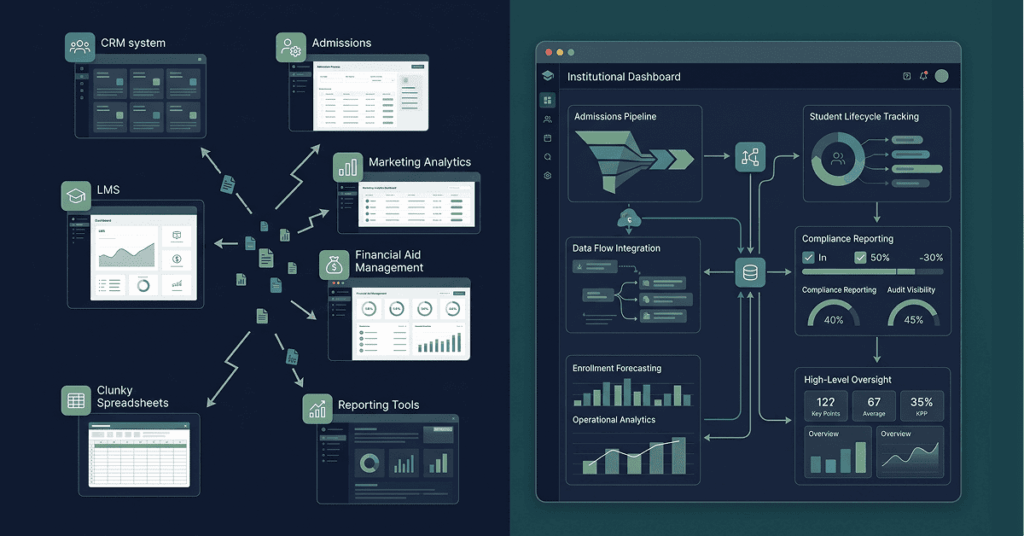
The Fragmented Data Problem
Common realities include:
- CRM data separate from CAS data
- Marketing metrics separate from admissions outcomes
- LMS data isolated from enrollment reporting
- Manual spreadsheets bridging system gaps
This fragmentation creates:
- Incomplete visibility
- Delayed decision-making
- Inaccurate forecasting
- Vendor dependency
In many institutions, critical operational data exists across multiple disconnected platforms with little integration between systems. Marketing teams track leads in one platform, admissions teams manage applicants in another, while academic and LMS reporting remain isolated from enrollment operations entirely. When data is distributed across platforms without integration, institutional leadership operates without full clarity.
Why Ownership Matters
Data ownership enables:
- Accurate intake forecasting
- Margin protection
- Compliance oversight
- AI integration readiness
- Lifecycle performance tracking
Institutions that consolidate and control their data infrastructure can make decisions based on real operational intelligence rather than assumptions or delayed reporting. Centralized visibility allows colleges to identify enrollment trends earlier, monitor admissions efficiency, improve student retention analysis, and strengthen compliance readiness. Institutions that control and consolidate their data can operate predictively rather than reactively.
Vendor Dependency Risk
Reliance on external platforms without centralized control increases switching costs and limits strategic flexibility. The next generation of Career Colleges will:
- Operate on a unified system of record
- Control their lifecycle data
- Integrate reporting across departments
- Use analytics to guide program strategy
Data ownership is not a technical issue. It is a governance issue.
Conclusion
As Career Colleges continue navigating increasing competition, compliance requirements, and operational complexity, data ownership will become a defining factor in institutional stability and long-term growth. Institutions that centralize and control their operational data will be better positioned to improve forecasting, strengthen decision-making, reduce dependency on fragmented systems, and adapt to future technological advancements.